
Biochemical Kinetics: Master the Differences Between Curly and Straight Hair Care
The cosmetic science of 2026 has transitioned from generalist beauty to “Molecular Trichology.” To the untrained eye, hair is merely a fiber, but to a scientist, it is a complex arrangement of sulfur-rich proteins and lipid bilayers. The differences between curly and straight hair care are governed by the laws of surface tension, tribology (the science of friction), and the hygroscopic nature of the keratin cortex. While straight hair behaves as a cohesive, low-friction bundle, curly hair functions as a high-friction, individualized helical structure.
By analyzing the chemical bonding and lipid distribution unique to each texture, we can develop more efficient protocols for hair health and longevity.
1. Tribology and Surface Friction
In physics, tribology is the study of interacting surfaces in relative motion. One of the most critical differences between curly and straight hair care lies in the “coefficient of friction.” Straight hair has a very low coefficient of friction; the fibers slide past one another with minimal resistance because the cuticles are aligned and the sebum coating is uniform.
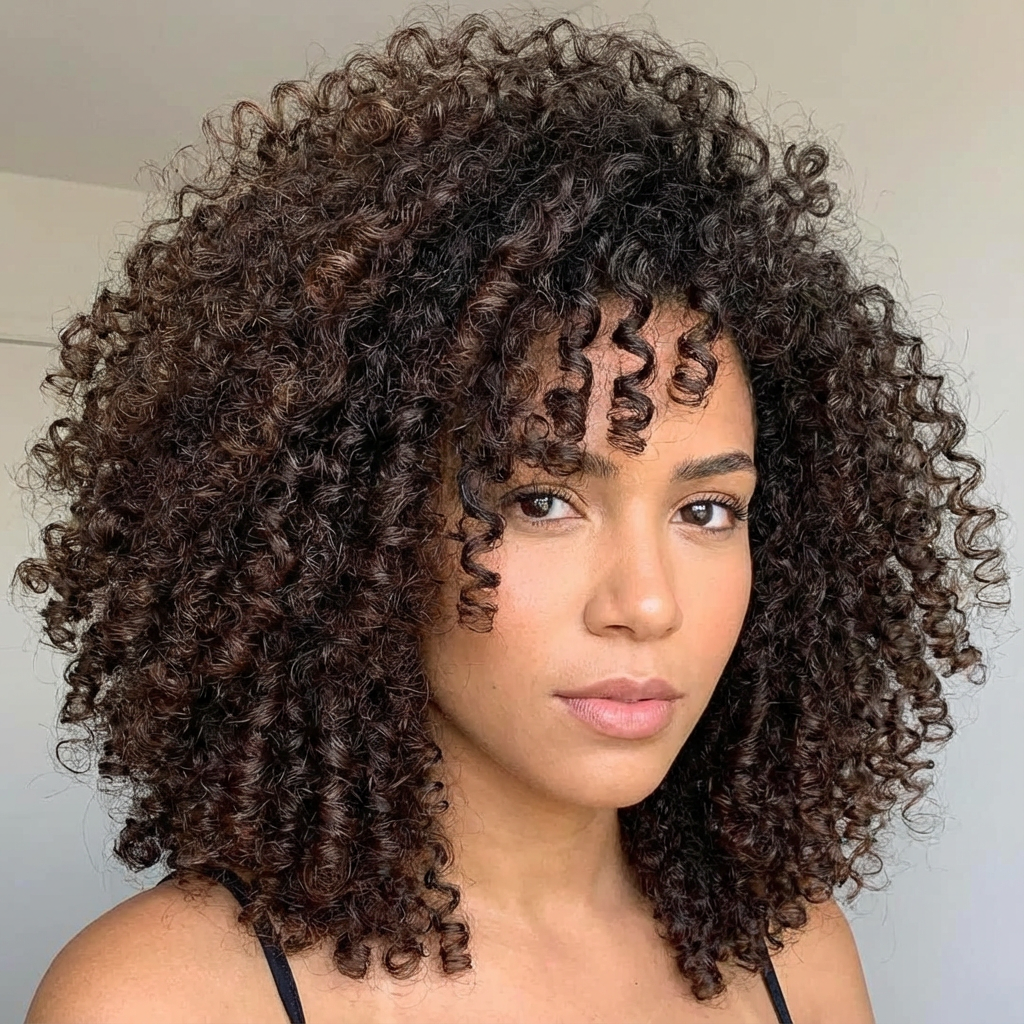
Curly hair, conversely, has a high coefficient of friction. The helical shape of the fibers causes them to “interlock” like gears. When curly hair moves, the cuticle scales of adjacent strands rub against each other, leading to “cuticle chipping.” Therefore, curly hair care must prioritize high-molecular-weight silicones or natural esters to artificially lower friction, a step that is often unnecessary or even detrimental (leading to limpness) for straight hair.
2. The Role of Hydrogen and Disulfide Bonding
Hair’s shape is held together by two main types of bonds: permanent disulfide bonds and temporary hydrogen bonds. In the context of the differences between curly and straight hair care, the “bonding density” per square micrometer is relatively similar, but the spatial arrangement is not.
In straight hair, hydrogen bonds are distributed symmetrically, allowing the hair to react to moisture in a predictable way. In curly hair, the bonds are “strained” due to the curve of the follicle. When humidity increases, the asymmetrical absorption of water molecules causes the hydrogen bonds to reset in a disordered fashion, leading to what we call “frizz.” Scientific management of curly hair involves “locking” these bonds with film-forming humectants, whereas straight hair management focuses on preventing the “collapse” of these bonds under the weight of excess moisture.
3. Lipid Diffusion and the Critical “Bend” Points
If we look at a hair strand under a scanning electron microscope (SEM), we can see that curly hair is not uniform in thickness. At the “bend” or the apex of a curl, the cortex is compressed on one side and stretched on the other. This stretching makes the cuticle layers thinner and more prone to “lipid leakage.”
This structural vulnerability is a key factor in the differences between curly and straight hair care. Straight hair has a robust, continuous lipid envelope. Curly hair has “leaky” spots at every curve. To compensate, curly hair requires “targeted lipid replenishment”—using oils with high penetration rates, such as coconut or argan oil, which can enter the cortex to replace lost internal fats. Straight hair, which retains its internal lipids well, requires only “surface-level” oils like jojoba to provide shine without penetrating the core.
4. Porosity Gradients and Chemical Penetration
Porosity—the ability of hair to absorb and retain moisture—varies significantly across different textures. Straight hair usually maintains a “low-to-medium” porosity gradient from root to tip. Curly hair, however, often exhibits “multi-zonal porosity.” The roots might be low porosity, while the mid-shaft and ends are high porosity due to the structural “stretching” mentioned previously.
Understanding these differences between curly and straight hair care is vital when applying chemical treatments. For instance, when dyeing hair, curly hair will absorb pigment much faster at the curves than at the straight sections, leading to “patchy” color results if not handled correctly. Pre-treatment “porosity equalizers” are essential for curly hair to ensure uniform chemical absorption, a step that is rarely a priority for healthy straight hair.
5. Hydrodynamic Cleansing: Micelles vs. Oils
The way we cleanse hair must respect its hydrodynamic properties. Straight hair can be cleansed using micellar technology—where small clusters of surfactants (micelles) trap oil and are easily rinsed away. This is effective for straight hair because the oil is mostly on the surface.
However, the differences between curly and straight hair care suggest that curly hair needs “emollient cleansing.” Since the lipids in curly hair are often trapped deep within the coils or are lacking entirely, harsh micellar action can strip the fiber to the point of “keratin fatigue.” In 2026, the scientific standard for curls is “acidic cream cleansing,” which uses a low pH to keep the cuticle closed while gently lifting surface dirt without disturbing the internal lipid balance.
6. Thermal Conductivity and Heat Management
Heat styling affects hair based on its surface area and density. Straight hair has a higher “thermal tolerance” because the heat can be distributed more evenly across the flat surface of the hair bundle.
One of the most dangerous differences between curly and straight hair care is how they react to a flat iron. In curly hair, the heat can get “trapped” in the coils, leading to localized “hot spots” that reach the keratin’s denaturation point (approx. 155°C-160°C) much faster than in straight hair. Curly hair therefore requires “thermal buffers”—ingredients that slow down the rate of heat conduction—to prevent the permanent “melting” of the alpha-helix proteins.
7. Scalp Microbiome and Texture
While often overlooked, the scalp microbiome is influenced by hair texture. Straight hair allows for the easy migration of Malassezia (a common yeast) and other microbes along the shaft. In curly hair, these microbes tend to stay concentrated on the scalp because the “helical stairs” are harder to climb.
This leads to another one of the differences between curly and straight hair care: scalp health. Straight-haired individuals are more prone to “oily dandruff,” where the oil and yeast mix on the hair shaft. Curly-haired individuals are more prone to “dry scalp inflammation,” where the microbes stay trapped at the root, causing irritation and potentially impacting the hair’s growth cycle. Scalp care for curls must focus on “soothing and hydration,” while scalp care for straight hair focuses on “regulation and exfoliation.”
8. Conclusion: The Unified Theory of Texture Care
While we have explored the many differences between curly and straight hair care, the ultimate goal remains the same: the preservation of the hair’s protein-lipid matrix. Whether you are managing a perfectly cylindrical straight fiber or a complex elliptical curl, the science of 2026 allows us to use precision ingredients to mimic nature’s best defenses. By respecting the unique physics and chemistry of your hair type, you can move away from trial-and-error and toward a scientifically validated routine that ensures your hair remains strong, elastic, and vibrant.