The Biophysical Impact of Styling: Analyzing the Effects of Heat and Hair Dyes on Hair
In the realm of advanced trichological research, the hair fiber is viewed as a high-performance biological polymer. Its durability is derived from a hierarchical structure consisting of the cuticle, the cortex, and the medulla, all held together by a sophisticated lipid-protein matrix. However, the integrity of this architecture is frequently compromised by modern grooming standards. To develop effective restoration protocols, it is critical to investigate the effects of heat and hair dyes on hair through the lens of molecular kinetics and protein denaturation.
As we move through 2026, clinical studies emphasize that the damage caused by thermal and chemical stressors is not merely superficial but involves a fundamental alteration of the hair’s crystalline structure.
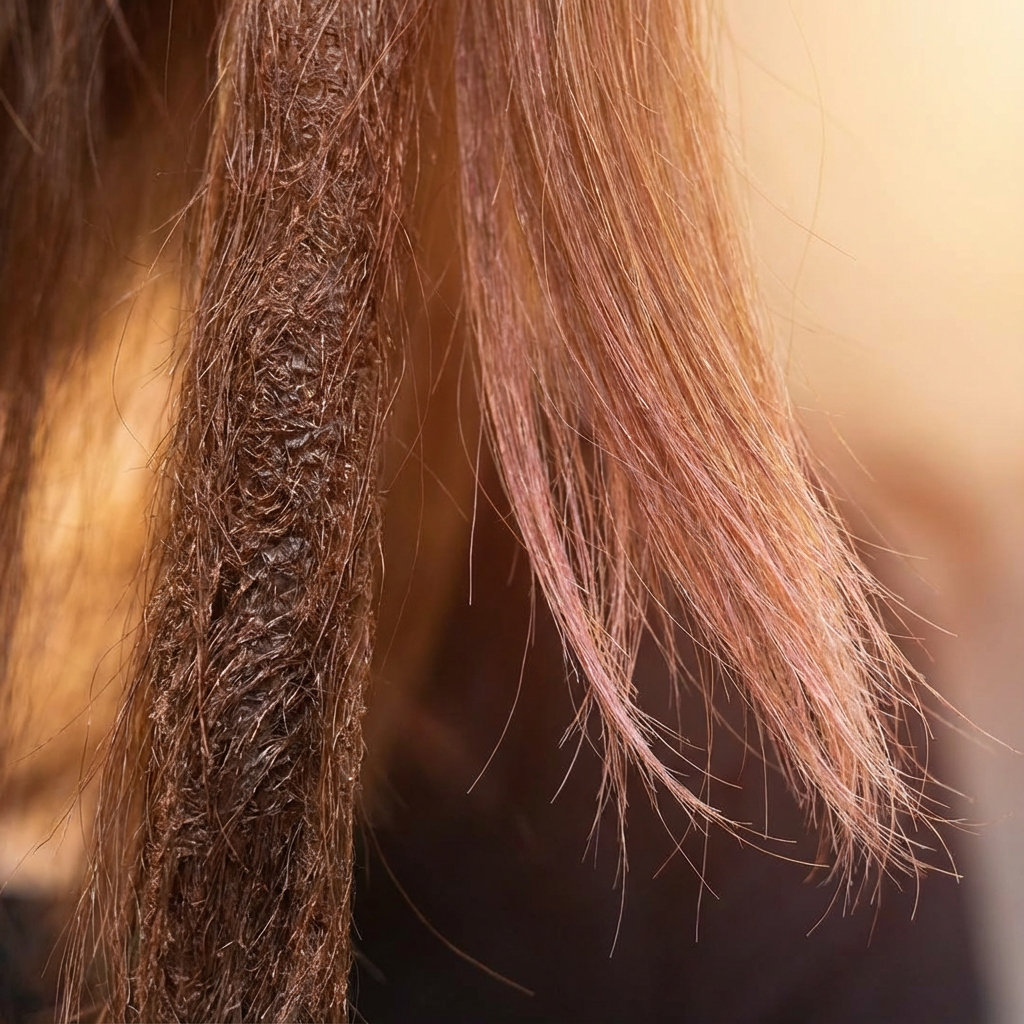
1. Thermal Degradation and the Glass Transition of Keratin
Hair keratin is a semi-crystalline material. Like all polymers, it possesses a glass transition temperature ($T_g$), which is the point at which the fiber shifts from a hard, “glassy” state to a soft, “rubbery” state. When styling tools are used, the primary objective is to reach this $T_g$ to reshape the hair. However, exceeding this threshold leads to permanent structural failure.
One of the most profound effects of heat and hair dyes on hair is the evaporation of “bound water.” Hair typically contains $10-15\%$ water by weight. Thermal tools operating above 130°C force this moisture out of the cortex so rapidly that it can lead to “intracortical bubbling.” This phenomenon creates microscopic voids within the hair shaft, significantly reducing its density and making the fiber susceptible to snapping under minimal mechanical stress.
2. Oxidative Stress and the Depletion of 18-MEA
The exterior of a healthy hair fiber is coated with a layer of 18-Methyleicosanoic acid (18-MEA). This fatty acid layer is what gives hair its hydrophobic (water-repelling) property and low-friction texture. The chemical effects of heat and hair dyes on hair are most visible in the total erosion of this lipid shield.
Permanent hair dyes utilize alkaline agents, such as ammonia, to swell the hair shaft and lift the cuticle scales.1 This process irreversibly strips the 18-MEA layer. Once this layer is removed, the hair becomes hydrophilic, absorbing water like a sponge. This leads to “hygral fatigue,” where the repeated swelling and shrinking of the fiber during washing and drying cycles causes the cuticle to delaminate and eventually flake off, leaving the cortex exposed to further environmental degradation.
3. The Cysteic Acid Index: A Measure of Chemical Trauma
The mechanical strength of hair is maintained by disulfide bonds—covalent links between cysteine amino acids. When hair is subjected to oxidative dyes or bleaching agents, these bonds are ruptured.2 A byproduct of this reaction is the formation of cysteic acid ($SO_3H$).
In clinical trichology, the concentration of cysteic acid is used as a primary biomarker to assess the effects of heat and hair dyes on hair. High levels of cysteic acid indicate that the hair has lost its internal “cross-linking,” resulting in a loss of elasticity. If heat is applied to hair that already has high cysteic acid levels, the thermal energy accelerates the breakdown of the remaining peptide chains, leading to a state where the hair can no longer hold its shape and becomes perpetually frizzy or “gummy” when wet.
4. Color-Induced Photodamage and Melanin Loss
Melanin does more than provide color; it acts as a biological photoprotector by absorbing and dissipating UV radiation.3 During the dyeing process, natural melanin is oxidized to allow synthetic pigments to settle in the cortex. However, synthetic pigments do not possess the same UV-shielding capabilities as natural eumelanin.
Consequently, one of the synergistic effects of heat and hair dyes on hair is an increased vulnerability to solar radiation. Without natural melanin to act as a buffer, UV rays can penetrate deeper into the cortex, causing “photo-bleaching” and further protein fragmentation. This is why colored hair often turns “brassy” or “straw-like” after sun exposure—the synthetic dyes have faded, and the underlying protein structure has been further weakened by radiation.
5. Cuticle Erosion and Intercellular Friction
The cuticle consists of 6 to 10 overlapping layers of scales. Healthy hair has a low coefficient of friction because these scales lie flat. However, the combined effects of heat and hair dyes on hair cause these scales to “weather” and curl upward.
Thermal tools can melt the “cuticle cement” (the Cell Membrane Complex), while dyes chemically erode it. This results in “inter-fiber friction,” where individual hair strands snag on one another. Under a scanning electron microscope (SEM), damaged hair shows jagged, broken cuticle edges. This increased friction leads to tangling and mechanical breakage during simple acts like combing or brushing, further thinning the hair over time.
6. Bio-Mechanical Repair: The 2026 Standards
To mitigate the effects of heat and hair dyes on hair, 2026 hair care technology has moved toward biomimetic molecular repair. Traditional conditioners only coat the surface, but new treatments aim to penetrate the cortex.
- Maleic Acid Derivatives: These act as “linkers” that temporarily mimic broken disulfide bonds, restoring some of the hair’s tensile strength.
- Synthetic 18-MEA: Laboratory-engineered lipids are now used to replace the lost natural oils, restoring hydrophobicity to the hair shaft.4
- Heat-Activated Polymers: Modern thermal protectors use cross-linking polymers that harden into a “sacrificial layer” when heat is applied, protecting the underlying keratin from reaching its denaturation point.
7. Porosity Management and pH Balancing
Because dyes raise the pH of the hair to an alkaline level (often pH 9-11), the hair stays in a “swollen” state long after the procedure is over. Managing the effects of heat and hair dyes on hair requires the use of acidic “sealing” treatments (pH 3.5-4.5) to force the cuticle scales back down.5 By lowering the hair’s porosity, we can prevent the leaching of color pigments and protect the inner cortex from further moisture loss. This pH management is crucial for maintaining the “shine” and “silkiness” associated with healthy hair.
8. Conclusion: The Science of Sustainable Aesthetic Expression
The human hair fiber is an engineering marvel, but it has its biological limits. The effects of heat and hair dyes on hair represent a cumulative tax on the hair’s structural integrity.6 By understanding the molecular mechanics—from the glass transition of keratin to the oxidation of disulfide bonds—we can adopt better protective habits. In 2026, the goal of hair science is to provide the tools for aesthetic transformation without sacrificing the fundamental health of the hair fiber. Through the strategic use of bond-building technology and thermal shields, it is possible to maintain a vibrant, colored, and styled look while preserving the protein matrix for the long term.